
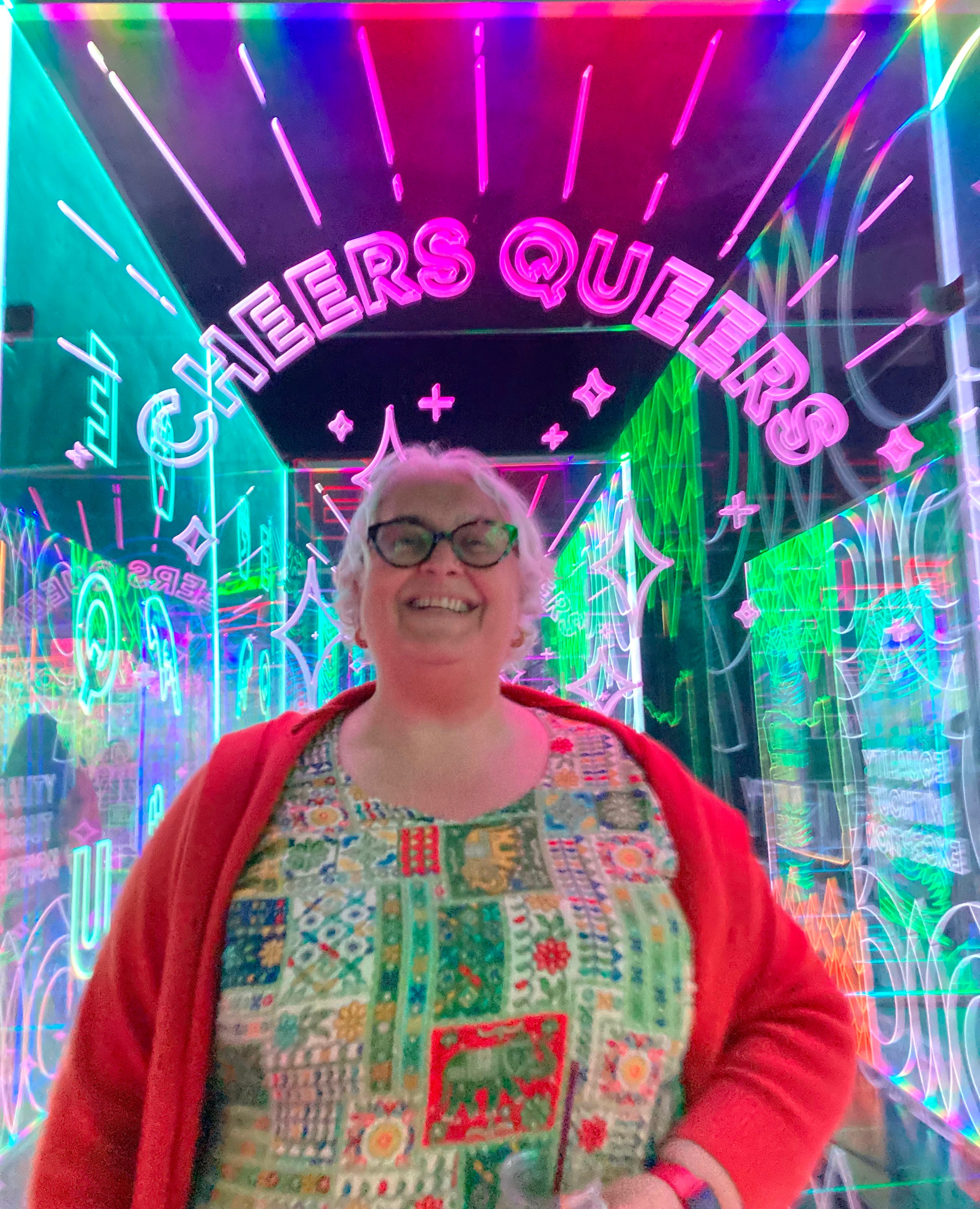
Me, as they/them
A tiny reflection amidst a much bigger moment

Hey, friend. I hope you’re finding some sources of hope and encouragement in this strange season of in-betweenness, with still too much violence while we continue to work for peace for all people.
I try to provide you with useful content, with citations and links and stuff like that, or with helpful tips on how to do little pieces of justice in your workplace or community group or family. I try not to go into personal stories any more than absolutely necessary (although you’ve been so supportive of my grad school adventures that I love updating you periodically on that stuff!)
But I did a class with some students the other week and shared a story that they found really moving, and it crossed my mind you might find it helpful or resonant or just interesting.
I’m sharing this partly because I’ve been sad to watch people I know absorbing a lot of right-wing narrative about trans rights without necessarily realizing how harmful those narratives are to trans folks and also to cis women and also ultimately to all people. Sometimes they even think they’re being progressive.
There are a lot of important conversations to have about those issues. This post isn’t that. In fact, even though it only happened a couple of months ago, it’s a little bit of a throwback to the days when more people were curious to learn more instead of determined that they already understood everything they could possibly need to know.

A few months ago I was having a conversation with a social justice elder that I know from my days at the Oakland Peace Center. She has done so many important things to make the world a better, more just place, and she brings so much humility to her work that it’s really striking.
As an aside, at the end of a conversation, she mentioned someone we both know and clarified that the person’s pronouns were they/them. She paused and said, “So, you use they/them pronouns, and you look like a woman. [That person] uses they/them pronouns, and they look like a man. Would you mind, if you’re comfortable, sharing your journey to using those pronouns?”
I was really moved by that framing, because it brought curiosity instead of judgment or assumption. In fact, that framing was why I brought up this story with my students—it was an example of cultural humility, which they were trying to think through in their workplace contexts.
If you’ve known me for a while (like this movement elder has), you may have noticed how I went from she/her pronouns to she/they pronouns (somewhere around 2017? I remember writing it on my nametag at a denominational gathering as a “solidarity” action), and then sometime in the pandemic (I want to say 2021) to they/them pronouns. I didn’t make a lot of noise about it, and I didn’t really try to correct people, but if people asked my pronouns, I was happy to tell them, and if they asked why, I was happy to have the conversation. (In fact, I’ve done a couple of newsletters on that, but so long ago I can’t link to them because they’re not on substack.)
So here’s what I shared with my friend. It may be stuff you already know, and also every person’s story varies a little.
I started out by saying “so it’s really important for me to say that people who identify as nonbinary have LOTS of reasons, so mine are probably not the same as [person we had just mentioned]. Some people feel like neither gender really speaks to them, that they’re in a different category. Some people feel like the way gender has been constructed is really harmful to everyone, and this is their way of creating a different path. I know some people who actually chose they/them pronouns after the last election as a sign of solidarity with trans people whose gender is being treated as a threat. There are a lot of reasons, rather than a single one.”
I can’t remember if I shared with her how one of my best friends from high school and I talked maybe ten years ago about how we loved that young people were using they/them pronouns, because that fit both of us better, but we were too old…and then when the pandemic hit and everyone was on zoom, it was a chance to reset how at least our work colleagues would identify us going forward. Without discussing it with each other, we both made the change, and then found out about it at least a couple of years after the fact (since we weren’t on zoom with each other that much).
I went on, “for me, it’s more about the whole range of gender expressions fitting me. I mean, you’ve known me for over ten years. You’ve seen me exhibiting what would be called masculine traits and you’ve seen me exhibit what would be called feminine traits. I really love a term I heard [another mutual colleague] use: ‘gender-full.’ It’s not so much that none of the gender identities fit; it’s that they all do.”
She lit up immediately. “Yes! That makes so much sense! I’ve seen you preach and speak and facilitate and all the different gender expressions show up!” Then she said, “why didn’t anyone explain it THAT way before?”
I think the answer to that is that people navigate this question so differently. I have friends who have medically transitioned and use different pronouns than the ones they were assigned at birth, and they also see themselves as “gender-full” or nonbinary; they’ve just found reference points that are right or easier for their public expression, and they’re more comfortable in their bodies. I have friends who use the pronouns they’ve had their whole lives who believe that bringing what I would call “gender-fullness” into their assigned gender is important, and it fits them better. And I have friends who use pronouns they feel fit them better but for whom surgery isn’t necessary or urgent.
My high school friend and I used to joke that we spent our lives just not doing “woman” correctly, and it was really freeing to realize that label might not be right for us. But I have friends who had the same experience growing up, for whom it is really important to show that there is no one right way of being a woman, or a man, and they are examples of another way of inhabiting that gender.
I think sometimes the subject of nonbinary identity can be sticky for me, because I have friends whose lives are at risk because of their visible trans-ness. I have friends whose security is at risk because they’re being forced to put the wrong gender on their travel documents, which has already resulted in harassment and physical harm to trans people going through airport security. My travel documents still say female, and it is definitely because the moments I want to talk about gender identity are not when a police officer pulls me over for a broken taillight or a TSA agent mistakes the books in my bag for something else. I absolutely benefit from what is called “cis [or cis-passing] privilege.” So it can feel a little indulgent to talk about this when much greater dangers to other trans friends are on the table right now (and have been for much of history).
But a friend of mine said the one advantage of talking about things like this in a moment like this is that it’s a reminder to other people that they get to be fully themselves, whatever that looks like.
So I wanted to share this story partly because you might have been curious and hadn’t known how to ask. You may not have thought to ask or figured you probably already knew (and you might have been right!). You might not have cared (in which case, the next newsletter will probably be more interesting!). Or you might have been trying to think through your own questions about gender identity.
But the main reason I wanted to share this story was because I was moved by the framing of the question I was asked. In this moment of the pressure to dig in, it is noteworthy when someone instead chooses to be open and curious. And not only curious about our opposition (a curiosity I feel often only goes in one direction), but curiosity about our friends. Relationships can deepen, and so can understanding, when we are curious about each other. It’s a lesson I keep needing to be reminded of, because I tend to think I know more than I do about my friends, and I have so much still to learn from and about them.
If you have thoughts on these questions, I’d love to hear them in the comments. Or, if they’re private, please feel free to respond to this newsletter and it will come just to me. I will do my best to respond.
I think you’ll get something from me before the end of the year, but in the mean time, happy Chanukah, happy solstice, happy Christmas, and happy Festivus to those who celebrate. <3
peace,
Sandhya
As ever, this is thoughtful and kind and compassionate, while also calling the reader to deeper thought and broader kindness. I'm so grateful for your voice.
My pronouns are We/Us
In solidarity with all human beings and identities.