

Hey, friend.
I spend a lot of time thinking about how we can get along better, not just for the sake of neighborliness, but because we need each other if we’re going to win any of our fights for justice. Like we used to say at the Oakland Peace Center, we need us.
A source of historic encouragement I came across recently has been the Sleepy Lagoon Defense Committee. Mexican Americans, Black Americans, labor unions, Jewish organizations, and Hollywood celebrities fought for two years on behalf of some Latine youth held unjustly, and they won.
Fair warning: this is part one of a two-part story. But this week’s part is worth holding on its own, because what happened with the Sleepy Lagoon Defense Committee in 1944 is one of the most instructive coalition stories in American history.
We are watching the same model be tested right now, with Kilmar Abrego Garcia and with thousands of others with names not all of us know. The question is the same: will the coalition hold long enough?
What’s Happening Right Now
The administration revoked the designation of schools, churches, hospitals, and courthouses as sensitive locations where immigration enforcement was previously limited. Raids have taken place at or near these locations since early 2025. The administration invoked the Alien Enemies Act of 1798 to deport people — predominantly Venezuelan — without due process hearings, with courts documenting that approximately 90% of those deported in one operation had no U.S. criminal record beyond traffic or immigration violations.
You may know the name of Kilmar Abrego Garcia, a first-year sheet metal apprentice with SMART Local 100, a father of three, a Maryland man with legal protected status1 who was wrongfully deported to El Salvador’s CECOT prison despite a court order protecting him. The labor movement showed up immediately. SMART General President Michael Coleman went on CNN: “Brother Kilmar was literally helping to build this great country. What did he get in return?” The AFL-CIO, UNITE HERE, and IUPAT signed a joint letter to the Salvadoran embassy.
As of late August 2026, the most recent information available I found shows that despite multiple court victories — criminal charges dismissed as vindictive prosecution in May 2026, a federal judge ordering his release from immigration detention in December 2025 — Kilmar remains in legal limbo. ICE re-arrested him after his release from prison and is now attempting to deport him to Eswatini, a small African country he has no connection to, where he’s never been and doesn’t speak the language. This is happening even though Costa Rica has indicated it would accept him, and Kilmar himself has said he would accept deportation there. The administration is choosing punishment over resolution.
The administration wrongfully deported him. When the Supreme Court ordered his return, they called it “an administrative error,” but the administration couldn’t leave it there. Instead, they invented charges: human smuggling. When judges questioned the timing, they added another layer: MS-13 allegations. When charges were dismissed as vindictive prosecution, they appealed. When he was released, they re-arrested him. Now they're trying to deport him to Eswatini. This was never about immigration enforcement. This is about an administration that cannot accept being held accountable, and Kilmar has become the proof of their refusal to do so.
And people are refusing to let what happens to him happen alone.
Sources:
ABC News timeline on Abrego Garcia through August 2026
CBS Baltimore - May 2026
Spectrum News - August 2026
The History We Should Have Learned (Part One)
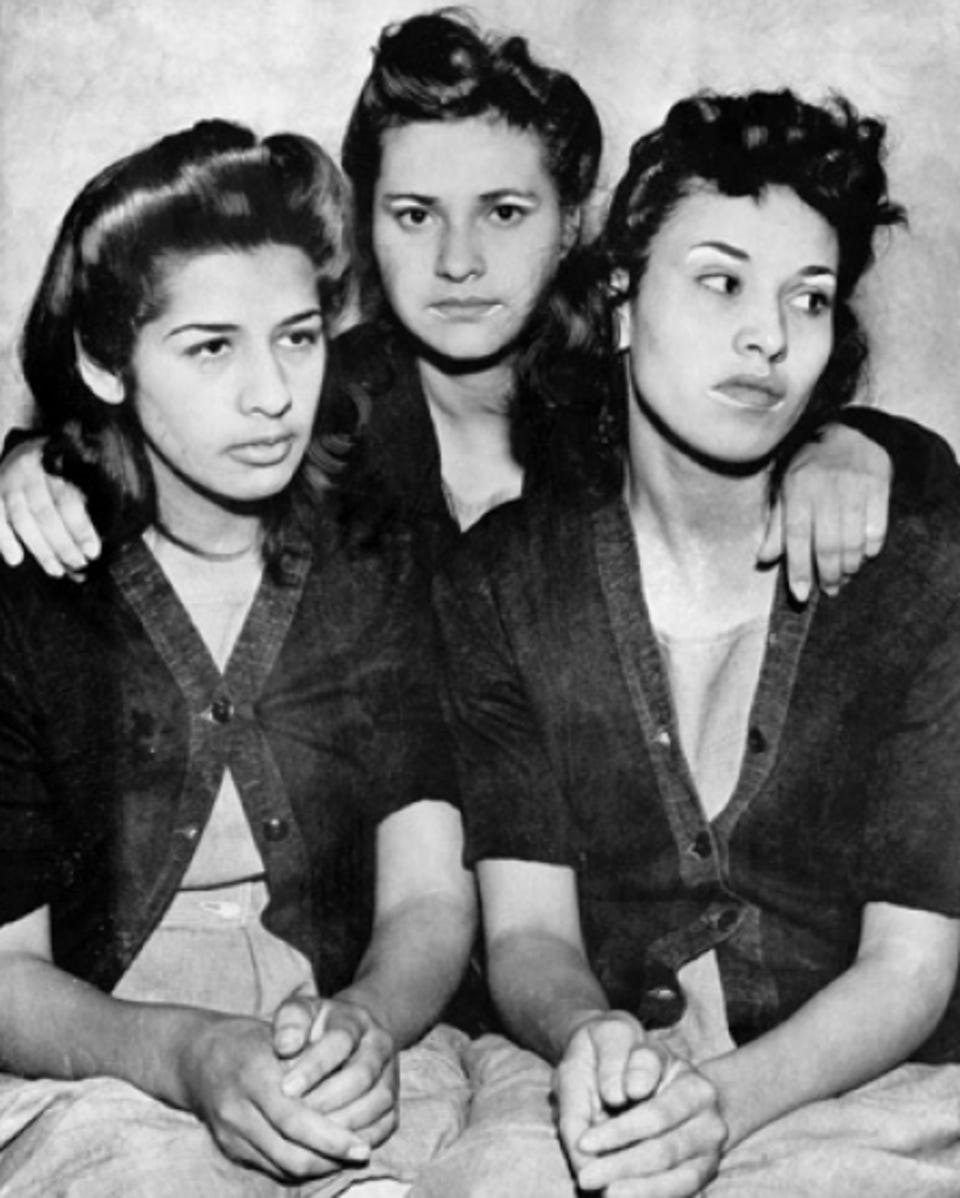
In August 1942, a young Mexican American man named José Díaz was found dying near a reservoir in Los Angeles that local kids called Sleepy Lagoon. The cause of death was never clearly established — he had been drinking, there had been a fight, he may have stumbled into the road. Nobody actually knew what happened.
The LAPD rounded up over six hundred young Mexican American men and women. Not because of evidence but because of their clothes, their haircuts, and the neighborhood they lived in. Twenty-two young men were put on trial together before an all-white jury. One prosecution witness testified that Mexicans had a racial propensity for violence rooted in (and this is what he actually said) pre-Columbian Aztec sacrifices. Twelve of the young men were convicted of murder and sent to San Quentin.
But here is what most history books leave out: the community organized immediately. A multiracial coalition called the Sleepy Lagoon Defense Committee formed within months: Mexican Americans, Black Americans, labor unions, Jewish community organizations, and Hollywood celebrities including Orson Welles, Anthony Quinn, and Rita Hayworth. They spent two years fighting the convictions. In October 1944, the California Court of Appeals unanimously overturned every single verdict. The young men came home.
And what happened between their conviction and their release — what happened in those two years, and what the Los Angeles establishment did in response — that’s next week’s story. But hold this first: the coalition assembled. They stayed together. They won.
For more:
A five-minute video here
A PBS SoCal story here
LA Law Library pamphlet here
A Saint You Should Know
Jessie Lopez de la Cruz had been a farmworker since she was five years old. She knew exactly what the work cost — the pesticides, the bent backs, the wages that never added up. When César Chavez came to her home in Parlier, California in 1965 to talk about forming a union, she started out making coffee. Then she started organizing.
She became the first woman recruiter for the United Farm Workers, going into the fields, town by town, signing up members. Between 1965 and 1972 she signed up more union members than any other UFW organizer. She ran the first UFW hiring hall out of her home, collecting dues, printing rally announcements, giving out donated groceries. She testified before the Senate. She helped push to ban the short-handled hoe — the tool that required farmworkers to bend at the waist for entire workdays and caused chronic, debilitating back injuries. She negotiated contracts. She helped end a ban on women pruning, opening up higher-paying field jobs to women for the first time. She was a delegate to the 1972 Democratic National Convention.
She was known for her quick wit, her humor, and her absolute refusal to accept that things had to be the way they were. She started organizing in her forties. She kept going until her nineties. She lived in a time when Chicana farmworkers were told their job was to support the movement — to make the coffee, not lead the strike. Today, when those same workers are being targeted by ICE raids and the labor rights the UFW built are being dismantled — Jessie Lopez de la Cruz went through it. And she left us a map. We are following it right now.
For more:
Jessie Lopez De La Cruz - Notable People
Good Trouble in Action
Here is something that is happening right now that doesn’t make the front page because it looks like paperwork — but it isn’t paperwork. It is the coordinated legal resistance of every major civil rights organization in America, filing together, strategizing together, showing up for each other’s communities in ways that are genuinely new.
In 2025, the ACLU took over 230 legal actions against the Trump administration. 64% of those lawsuits delayed, diluted, or defeated the administration’s agenda. But what matters as much as the wins is who is fighting alongside them. When the Trump administration issued an executive order attempting to transform the U.S. Postal Service into an arbiter of who may cast a ballot by mail, a coalition filed a joint lawsuit in federal court: the ACLU, the Brennan Center for Justice, the NAACP Legal Defense Fund, Asian Americans Advancing Justice, and LatinoJustice PRLDEF — organizations built to fight for different communities, filing together.
The organizations that built their legal frameworks to fight for Black Americans, Latino Americans, Asian Americans, immigrants, women, LGBTQ people, and disabled people are coordinating strategy and showing up for each other’s communities with a shared understanding: an attack on any constitutional protection is an attack on all of them. That is the Sleepy Lagoon Defense Committee model, in courtrooms, in 2026. A multiracial coalition built around one clear goal — the Constitution means what it says — and they are winning more than half the time.
For more:
Federal Court Grants Emergency Relief Blocking USPS From Implementing Newly-Finalized Mail Ballot Rule For November Election | American Civil Liberties Union August 27, 2026
Solidarity Is Already Happening
When the Trump administration began its mass deportation operations in early 2025, the North America’s Building Trades Unions — representing bricklayers, electricians, plumbers, iron workers, carpenters, and sheet metal workers — made a principle explicit: when any worker is targeted for being an immigrant, every worker is threatened. SEIU Healthcare workers in California organized rapid response networks to protect workers if ICE came to their workplaces. UNITE HERE hotel workers in Chicago organized Know Your Rights trainings in multiple languages.
These are not symbolic gestures. They are workers protecting each other. The coalition model that freed twelve young men from San Quentin in 1944 is alive in 2026. Unions showing up for a sheet metal worker. Civil rights organizations filing together. Neighbors standing beside neighbors. The bandana is still red.
For more:
Immigrant and Worker Justice Toolkit - Washington State Labor Council, AFL-CIO
An Injury to One is an Injury to All: Resources for Immigrant Workers and Allies | Labor Notes
Jessie Lopez de la Cruz started organizing in her forties and kept going until her nineties. The coalition that freed twelve young men from San Quentin held together for two years in the 1940s. The labor movement went on CNN for a worker they barely knew. These are acts of what South Africans call “ubuntu,” that principle of “I am because you are.”
Next week, I’m going to show you what happened while those young men were sitting in San Quentin. It’s the part of the story I thought I already knew. Looking forward to hearing if it rings any bells for you.
peace,
Sandhya
Something a lot of us are learning or re-learning is that the law is a moving target with immigration. The most recent example is how suddenly Haitians who were protected by Temporary Protection Status suddenly lost it, and others with that same status worry they will be next. Many immigration and refugee statuses have been radically overhauled recently; I wanted to note that in relation to this, because when we argue someone’s right to be here because they came legally, it’s worth being aware of how often loopholes in the law or quick changes to the law can move someone from one category to another with absolutely nothing changing about their life or situation.
Excellent article ty! I tell my Haitian friend who is a US citizen to carry her passport or paper with her just in case. Her accent is an easy target.